

A Hotel Financial Model translates the operating assumptions of a proposed or existing hotel into financial forecasts that indicate whether the property can generate sufficient revenue, cash flow, and investment returns to justify the required capital.
That sounds simple. Hotel economics are not.
Unlike many businesses, a hotel sells the same perishable inventory every night. A room that remains empty tonight cannot be stored and sold twice tomorrow. Revenue therefore depends on the interaction between room inventory, occupancy, average daily rate, seasonality and customer mix. Profitability then depends on how effectively that revenue covers staffing, housekeeping, utilities, food and beverage, maintenance, distribution costs, management fees, property costs and financing.
For a new development, the model must go further. It needs to connect land, construction expenditure, furniture, fixtures and equipment (FF&E), pre-opening expenditure, and funding requirements to the period during which the hotel opens, ramps up, and eventually reaches stabilised operations.
The objective is not merely to answer:
“How profitable could this hotel become?”
It must also answer:
“How much capital does it require, when does it require it, how quickly can occupancy ramp up, can the debt be serviced, and does the expected return justify the investment risk?”
This guide explains how to build a hotel financial model, prepare realistic hotel financial projections, conduct market research, calculate hospitality KPIs such as ADR, RevPAR and GOPPAR, structure development funding, prepare a hotel business plan and evaluate the project before committing substantial capital.
A hotel financial model is an integrated forecasting tool that translates hotel-specific operational, development and financing assumptions into projected financial statements, cash requirements, performance indicators and investment returns.
A robust hotel model normally combines four layers:
The Best Financial Models Hotel Financial Model Excel uses this structure across a 10-year forecast. It connects room inventory, occupancy, ADR, ancillary revenues, construction CAPEX, operating expenses and debt/equity assumptions with integrated financial statements, hotel KPIs and valuation outputs.
The important word is integrated.
If occupancy falls, room revenue should fall automatically. That should affect departmental profitability, cash flow, tax, funding requirements and valuation without manually changing five separate worksheets.
That is the difference between a genuine financial model and a spreadsheet containing numbers that happen to be arranged in columns.

These documents overlap, but they answer different questions.
| Document | Main Question | Primary Purpose |
|---|---|---|
| Hotel feasibility study | Should this hotel be developed? | Tests market, site, concept and financial viability |
| Hotel business plan | How will the hotel be developed, funded, marketed and operated? | Creates the strategic and funding roadmap |
| Hotel financial model | What do the assumptions mean financially? | Quantifies revenue, costs, cash flow, funding and returns |
Hospitality feasibility specialists such as HVS and Horwath HTL explicitly connect market analysis, hotel positioning and demand forecasts with financial projections and investment returns.
The logical sequence for a significant hotel development is therefore often:
Market Research → Concept → Feasibility → Financial Model → Go / No-Go / Conditional Go → Business Plan → Funding → Development → Operations.
For a smaller independent hotel or conversion project, several of these stages may be combined.
If you are starting a hotel, do not begin by forecasting revenue.
Start by establishing what you are actually proposing to build.
Determine:
A 30-room boutique hotel and a 300-room convention hotel may both sell bedrooms, but they are very different businesses economically.
Review:
Ask who will actually sleep in the rooms.
Possible segments include:
Build a realistic competitive set rather than comparing the proposed hotel to the nearby property with the highest room rate.
CoStar/STR defines a competitive set as a group of hotels that compete with the subject property and uses competitive benchmarking extensively for occupancy, ADR, and RevPAR.
Current competition tells only half the story.
A market with six hotels today may have four more under construction.
Lodging Econometrics tracks projects by development stage and forecasts future hotel openings across markets worldwide, making pipeline analysis useful when assessing future supply risk.
Decide whether the market can support:
Do not add facilities simply because they make the architectural rendering prettier.
They must either support room demand, improve pricing power, generate profitable independent revenue or strengthen the overall investment case.
Obtain realistic estimates for land, professional fees, construction, FF&E, operating equipment, technology, pre-opening expenditure and contingency.
Translate the market and development assumptions into revenue, operating expenses, cash flow and investment returns.
Test lower occupancy, weaker ADR, delayed opening, cost overruns and higher financing costs.
The business plan should explain why the assumptions contained in the financial model are commercially supportable and how the project will be developed and operated.
A hotel forecast should never begin with:
“We think we can achieve 75% occupancy.”
The research needs to explain why.
A professional hotel market assessment should examine:
Historical hotel performance is only one part of this analysis. Tourism Economics notes that hotel demand, occupancy, rate and asset value can also be influenced by economic conditions, traveller behaviour, air access, events, supply growth and destination strength.
| Tool / Source | Useful For |
|---|---|
| CoStar with STR Benchmark | Occupancy, ADR, RevPAR, competitive sets, benchmarking and hotel performance |
| Tourism Economics | Travel demand, visitor forecasts, occupancy, ADR and RevPAR forecasts |
| Lodging Econometrics | Existing supply, hotel development pipelines and future openings |
| Lighthouse | Competitor pricing, rate shopping and forward-looking demand signals |
| National tourism/statistics authorities | Visitor arrivals, accommodation statistics and source-market information |
| Local tourism organisations | Events, destination developments and visitor profiles |
| Primary research | Interviews with corporates, travel agents, tour operators and other local demand generators |
CoStar says STR’s directly sourced sample now covers more than 90,000 participating hotels globally. Tourism Economics provides travel forecasts across more than 185 countries, while Lighthouse provides forward-looking hotel search and pricing signals.
These tools inform the assumptions.
They do not replace the financial model.
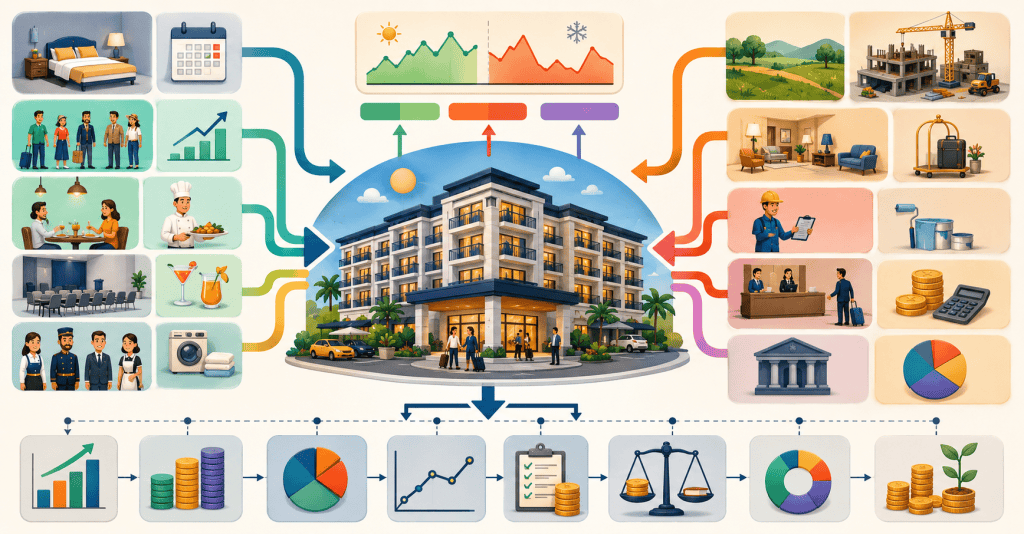
A hotel forecast should be constructed from operating drivers rather than by deciding what revenue you would like to see in Year 5.
The first calculation is hotel inventory.
Available Room Nights = Rooms Available × Days in the Period
A 120-room hotel operating for 365 days has:
120 × 365 = 43,800 available room nights per year.
This represents the maximum annual room inventory before accounting for temporary closures or rooms taken out of service.
Occupancy measures the percentage of available rooms sold.
CoStar/STR defines occupancy as:
Occupancy = Rooms Sold ÷ Rooms Available
If the 120-room hotel sells 28,470 room nights:
28,470 ÷ 43,800 = 65% occupancy.
For a new hotel, do not assume stabilised occupancy immediately.
The model should normally include an operating ramp-up while the hotel establishes distribution, brand awareness, corporate contracts, reviews and repeat customers.
Average Daily Rate (ADR) measures the average room rate actually earned on rooms sold.
The industry formula is:
ADR = Room Revenue ÷ Rooms Sold
If the hotel sells 28,470 room nights at an average realised rate of $180:
28,470 × $180 = $5,124,600 annual room revenue.
Your ADR forecast should reflect:
Do not confuse the rack rate displayed on the hotel’s website with the ADR that the property will actually realise.
Revenue per Available Room (RevPAR) combines room rate and occupancy into a single top-line hotel performance metric.
RevPAR = Room Revenue ÷ Available Rooms
It can also be expressed as:
RevPAR = ADR × Occupancy
CoStar/STR describes RevPAR as a core hotel top-line performance metric because it reflects both room price and room utilisation.
Using the example:
$180 ADR × 65% occupancy = $117 RevPAR.
This tells the investor more than occupancy, or ADR viewed independently.
A hotel achieving 90% occupancy by discounting heavily may generate less RevPAR than a hotel operating at lower occupancy but substantially higher rates.
Room revenue is only one component of many hotel business models.
Depending on the concept, additional revenue can come from:
CoStar/STR defines total hotel revenue broadly to include rooms, F&B, other operating departments and miscellaneous revenue such as rentals and fees.
The BFM Hotel Financial Model can model up to 20 room types and additional revenue activities including restaurants, casino operations, golf, events, parking, retail leasing and other hospitality or leisure facilities.
Each material revenue stream should have its own driver.
For example:
Restaurant Revenue = Covers × Average Spend
Parking Revenue = Paid Parking Hours × Hourly Rate
Conference Revenue = Events × Average Event Revenue
Golf Membership Revenue = Members × Membership Fee
Do not apply one generic 8% annual growth rate to every revenue stream.
A hotel is a collection of operating businesses sharing one property.
Annual averages can hide enormous differences between individual months.
A coastal resort may operate near capacity during summer while struggling through winter. A city hotel may perform strongly midweek but weaken at weekends. An event-driven hotel may experience several extraordinary periods each year.
The model should therefore consider:
A model forecasting 70% occupancy every month because annual occupancy is expected to average 70% may get the annual arithmetic right while completely misrepresenting cash flow.
That matters when payroll, debt service and fixed costs continue through the weaker months.
Hotel expenses should be linked to how the property actually operates.
A useful starting distinction is between:
These move more directly with occupancy or departmental revenue.
Examples include:
These may continue even when occupancy falls.
Examples include:
These increase once activity reaches specific levels.
A second housekeeping team, additional kitchen staff or a larger management structure may become necessary only after the hotel reaches a particular occupancy or scale.
Where appropriate, hotel P&L structures can also be aligned with the Uniform System of Accounts for the Lodging Industry (USALI). CoStar’s current STR reporting guidelines state that they align with the 12th Revised Edition where possible, supporting consistency in hotel benchmarking and profitability analysis.
A professional model should contain more than a revenue forecast and profit-and-loss statement.
| Model Component | Purpose |
|---|---|
| Assumptions | Centralises all key inputs |
| Room inventory | Models room types and available nights |
| Occupancy forecast | Determines rooms sold |
| ADR forecast | Determines realised room pricing |
| Room revenue | Combines occupancy and rate |
| Ancillary revenue | Captures F&B and other operating departments |
| Staffing schedule | Forecasts headcount and payroll |
| Operating expenses | Models fixed and variable costs |
| Development CAPEX | Captures land, construction and fit-out |
| FF&E | Models furniture, fixtures and equipment |
| Pre-opening costs | Captures expenditure before trading begins |
| Working capital | Calculates operating cash requirements |
| Debt schedule | Models interest, drawdowns and repayments |
| Equity schedule | Models sponsor and investor funding |
| Income Statement | Forecasts operating profitability |
| Cash Flow Statement | Forecasts cash generation and funding needs |
| Balance Sheet | Forecasts assets, liabilities and equity |
| Hotel KPIs | Tracks occupancy, ADR, RevPAR and profitability |
| Break-even | Identifies required operating performance |
| Sensitivity analysis | Tests weaker/stronger assumptions |
| Valuation | Calculates investment value and returns |
This is why a generic small-business spreadsheet is usually inadequate for a material hotel development.

A bankable or investor-ready hotel model should normally integrate three financial statements.
The projected income statement should show:
The cash-flow forecast shows what the accounting profit cannot:
when money actually enters and leaves the project.
For a hotel development, this is particularly important because cash may leave the project for months or years during construction before the first guest checks in.
The model should capture:
The projected balance sheet should include the following:
All three statements should reconcile.
For a more comprehensive guide, see “Financial Projections for a Business Plan.”
A hotel financial model should directly link operating performance to recognised hotel KPIs. The definitions below follow the hospitality benchmarking terminology used by CoStar/STR.
Occupancy = Rooms Sold ÷ Rooms Available
Measures utilisation of room inventory.
ADR = Room Revenue ÷ Rooms Sold
Measures the average realised room rate.
RevPAR = Room Revenue ÷ Rooms Available
or
RevPAR = ADR × Occupancy
Measures room-revenue performance across total room capacity.
TRevPAR = Total Hotel Revenue ÷ Available Rooms
Unlike RevPAR, TRevPAR incorporates revenue beyond guest rooms.
GOPPAR = Gross Operating Profit ÷ Available Rooms
GOPPAR shifts the focus from revenue generation to the operating profit produced by the available room inventory. CoStar describes it as an important bottom-line hospitality metric because it incorporates both revenue generation and control of operating expenses.
Consider two hotels with identical RevPAR.
Hotel A may generate that revenue with an efficient staffing and operating structure.
Hotel B may require substantially more labour, utilities and marketing expenditure.
RevPAR says their room-revenue performance is similar.
GOPPAR reveals that their profitability may not be.
For an investor, both matter.
A comprehensive hotel business plan should normally summarise:
The business plan does not need to reproduce every worksheet in the model.
Its job is to show the assumptions, principal outputs and commercial implications in a format the reader can understand.
The Excel model is the engine.
The business plan explains where the vehicle is going.
One of the most useful feasibility outputs is break-even occupancy.
At a simplified level, it asks:
“What minimum level of occupied rooms and supporting revenue is required for the hotel to cover its operating costs?”
A full calculation needs to recognise that:
Your hotel financial model should therefore calculate break-even dynamically rather than relying on one generic industry percentage.
For funding analysis, you may also need to distinguish:
Those are not necessarily the same point.
A financial model for a new hotel must capture the complete development cost, not simply building construction.
Typical categories include:
The BFM model specifically connects hotel development expenditure, FF&E, pre-opening costs and phased capital requirements with the project’s financial forecasts and funding assumptions.
The correct funding question is therefore not:
“What does the building cost?”
It is:
“How much cash is required from land acquisition until the hotel can sustain itself?”
Hotel development is capital-intensive, so projects often draw on multiple sources of funding.
Potential sources include:
| Funding Source | Typical Role |
|---|---|
| Sponsor/founder equity | Initial risk capital |
| Commercial bank debt | Senior development or property financing |
| Construction finance | Funds build-phase expenditure |
| Private debt | Alternative senior or subordinated capital |
| Private equity | Equity capital in exchange for ownership |
| Joint-venture investor | Shares development capital and returns |
| Family office/institutional investor | Long-term equity or structured capital |
| Mezzanine finance | Higher-risk capital between senior debt and equity |
| Preferred equity | Equity with preferential return rights |
| Government/DFI funding | May be available depending on jurisdiction and project mandate |
| Tourism/development incentives | Grants, tax or investment incentives where locally available |
Global real estate capital advisers such as CBRE and JLL work with financing structures involving commercial lenders, private credit, institutional investors, senior debt, mezzanine finance, and other structured capital sources.
The optimal capital structure depends on:
There is no universal ideal debt-to-equity ratio for every hotel.
Model several structures and compare the effect on cash flow, debt service and equity returns.
Do not simply add a loan to the assumptions sheet and subtract repayments every year.
The debt schedule may need to model:
A project may be profitable over ten years and still fail because debt payments become due before operations generate enough cash.
This is why liquidity and debt-service analysis matter alongside IRR.
A hotel is both an operating business and a real-estate investment.
A robust development model should therefore evaluate the cash flows produced by the operation and the value of the investment over the investor’s holding period.
Useful measures include:
The BFM Hotel Financial Model includes DCF, IRR, NPV, payback and hotel-specific valuation outputs across its 10-year horizon. This product page includes a step-by-step video walkthrough and sample PDF preview pages so users can see exactly how the Hotel Financial Model Excel template is structured before purchasing.
For a detailed explanation of IRR, see How to Calculate Internal Rate of Return in Excel.
A single financial forecast is not a feasibility analysis.
At minimum, test:
| Scenario | Assumption Tested |
|---|---|
| Base Case | Most supportable operating assumptions |
| Slow Ramp-Up | Occupancy takes longer to stabilise |
| ADR Pressure | Realised rates are below forecast |
| Construction Overrun | Development costs increase |
| Opening Delay | Hotel opens later than planned |
| OPEX Stress | Payroll/utilities/other costs increase |
| Higher Interest | Financing becomes more expensive |
| Combined Downside | Occupancy falls while costs rise |
| Upside | Stronger occupancy and ADR |
Hotel feasibility work routinely tests changes in occupancy, ADR and operating costs because these assumptions directly affect financial viability and investment returns.
A 20% project IRR in the base case tells you something.
A 20% base-case IRR that becomes 7% after a modest occupancy reduction tells you considerably more.
A detailed hotel business plan should connect the market opportunity, development concept, operating plan and financial model.
For funding-specific considerations, see JTB Consulting’s guide to preparing a Business Plan for Funding.
The executive summary should present the investment case rather than summarising twenty-five headings.
A good hotel executive summary answers eight questions:
A practical structure is:
The proposed [hotel name] is a [number]-room [category/positioning] hotel planned for [location], targeting [principal customer segments]. Independent market analysis indicates demand from [key demand generators], supported by [relevant market evidence]. The development will include [principal facilities] and requires total investment of approximately [amount], funded through [equity/debt structure]. Based on the assumptions tested, the hotel is forecast to achieve stabilised occupancy of [x%], ADR of [amount] and RevPAR of [amount], producing [headline profitability/cash-flow metric]. Funding of [amount] is sought for [specific use], with projected debt-service capacity/investor returns supported by the detailed financial model.
Use your own evidence and financial outputs.
Do not fill the brackets with numbers chosen because they make the paragraph sound impressive.
For development feasibility and investor underwriting, Microsoft Excel remains one of the most flexible tools because assumptions, development costs, operating schedules, financing, financial statements, scenarios and valuation can be integrated transparently in one workbook.
The difficulty is not Excel itself.
It is building the model architecture correctly.
| Tool | Best Use |
|---|---|
| Microsoft Excel | Custom hotel forecasting and investment modelling |
| Best Financial Models Hotel Model | Ready-built 10-year Excel development, feasibility and valuation model |
| CoStar with STR Benchmark | Hotel benchmarking and market performance data |
| Lighthouse | Rates, competitor pricing and forward demand intelligence |
| Tourism Economics | Tourism demand and hotel-market forecasts |
| Lodging Econometrics | Hotel construction pipeline and future supply |
The Hotel Financial Model Excel Template is useful when you want the modelling architecture already built but still want full control over assumptions.
Its workflow follows:
Inputs → Calculations → Outputs
and currently includes:
The product page also includes a video walkthrough and sample preview material so users can inspect the model structure before purchasing.
If building your own workbook from scratch, use a modular structure.
A practical Excel workbook might contain:
Keep inputs separate from calculations.
Avoid hard-coding assumptions repeatedly into formulas.
If changing occupancy from 65% to 60% requires editing nineteen worksheets manually, you have not built a dynamic hotel financial model.
You have built an administrative problem.
A ready-built template can work well when:
A bespoke assignment is usually more appropriate where:
Examples of established hospitality and real-estate advisory organisations offering hotel feasibility, market, valuation or development advisory services include:
The right advisor depends on whether you need specialist hospitality feasibility, property valuation, capital-markets advice, market research, business planning, financial modelling or a combination of these.
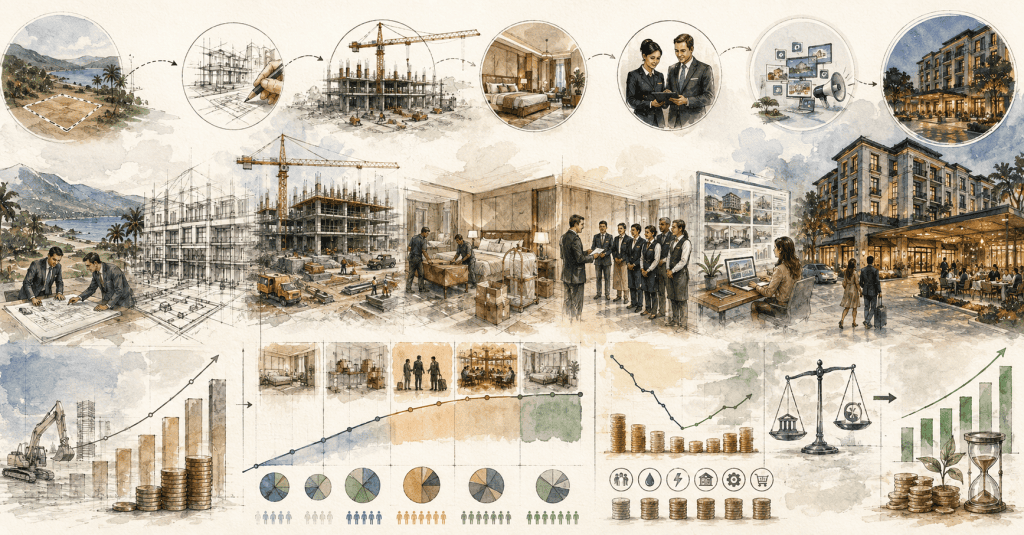
Before committing capital to a new hotel, confirm that:
If several of these items remain unresolved, the project is probably not ready for a final investment decision.
A hotel financial model is an integrated forecast that converts room inventory, occupancy, ADR, ancillary revenue, operating expenses, development costs and funding assumptions into financial statements, hotel KPIs, cash requirements and investment returns.
Core components include room inventory, occupancy, ADR, room revenue, ancillary revenue, payroll, operating expenses, CAPEX, working capital, debt/equity funding, integrated financial statements, hotel KPIs, break-even analysis, scenarios and valuation.
RevPAR equals room revenue divided by the number of available rooms. It can also be calculated as ADR multiplied by occupancy.
GOPPAR equals gross operating profit divided by the total number of available rooms. It measures how effectively a hotel converts revenue into operating profit across its room inventory.
Include occupancy, ADR, RevPAR, room and ancillary revenue, operating expenses, profitability, cash flow, balance sheet, CAPEX, funding requirements, debt repayments, break-even, IRR, NPV and valuation where appropriate.
Excel is particularly suitable for transparent development and investment modelling. Specialist data tools such as CoStar/STR, Lighthouse, Tourism Economics, and Lodging Econometrics can support the market assumptions that feed the model, while a ready-built Excel template can eliminate the need to construct the financial architecture from scratch.
BestFinancialModels.com provides a dedicated Hotel Financial Model Excel covering ten-year forecasting, room revenue, ancillary income, development CAPEX, funding, integrated financial statements, hotel KPIs and valuation.
Potential sources include sponsor equity, bank debt, construction finance, private credit, private equity, joint-venture investors, family offices, mezzanine capital, preferred equity and government or development-finance programmes where available. The appropriate mix depends on the project’s location, risk, cash flow and total capital requirement.
The appropriate period depends on the investment. A development model often needs to extend beyond construction and opening far enough to show operational ramp-up, stabilised performance, debt servicing and investor returns. The BFM Hotel Financial Model uses a ten-year horizon for this reason.
For a material new hotel investment, feasibility analysis is highly valuable because it connects site, market demand, competition, concept, development cost and projected financial performance before capital is committed. Major hospitality advisory firms structure hotel development studies around precisely these factors.
Entrepreneurs, developers, investors and advisors who want to undertake their own modelling can use the Best Financial Models Hotel Financial Model Excel.
It provides the modelling architecture for:
The template is fully Excel-based, with assumptions feeding calculations, integrated financial statements, KPIs and valuation outputs through a structured Inputs → Calculations → Outputs workflow.
The product page includes the detailed video walkthrough and preview material so you can review how the model works before purchasing.
View the Hotel Financial Model Excel Template.
A template is not always the right solution.
For projects requiring independent market research, a comprehensive hotel business plan, feasibility analysis, complex funding structures or a bespoke integrated financial model, JTB Consulting provides customised business planning and financial modelling support.
This is particularly relevant where the hotel is being developed for external investors, bank funding or a formal investment decision and the assumptions themselves need to be researched and defended.
The question at the end of a hotel feasibility process should not simply be:
“Can we build it?”
It should be:
“Does market demand support this hotel, can it generate enough cash to fund its operations and debt, and will the resulting return justify the capital and risk involved?”
That is what a properly constructed hotel financial model should answer.