

A Padel Club Financial Model is a financial blueprint that assesses whether a proposed padel facility can generate sufficient court revenue, membership fees, coaching income, and ancillary sales to cover its startup costs and ongoing operating expenses.
That matters because how to start a padel club is not simply a matter of finding a site, installing courts and waiting for players to arrive.
The economics of a padel club depend heavily on court utilisation, peak and off-peak pricing, operating hours, membership behaviour, coaching activity, tournaments, staffing, rent or property costs, construction costs, maintenance, funding and the amount customers spend beyond the court itself.
Padel continues to expand across established and emerging markets. Playtomic, one of the largest specialist racket-sport booking platforms, currently reports more than 6,700 clubs, 25,000 courts and 1.7 million monthly active players on its network. Yet rapid growth does not automatically make every new padel club profitable. Recent reporting has also documented club closures in markets such as Sweden and Chile, driven by aggressive expansion and excess supply.
The commercial question is therefore not simply:
“Is padel growing?”
It is:
“Can this specific padel club, in this specific location, achieve enough paid court-hours and additional revenue to recover its investment and produce an acceptable return?”
This guide explains how to start a padel club, how to prepare a padel club business plan, what startup costs to include, how to forecast court utilisation and revenue, how memberships affect the economics, what financial metrics matter, how to market the club and how to build an integrated padel club financial model for investors, lenders or your own feasibility assessment.
A padel club business model explains how a facility attracts players, monetises its available court capacity and converts playing activity into sustainable revenue, profit and cash flow.
The central unit of economics is usually the court-hour.
Every court has a finite number of hours available for sale every day. If a court operates for 14 hours, you have 14 potential court-hours of inventory. Once a particular hour passes unused, it cannot be stored and sold tomorrow.
A successful padel business therefore tries to optimise three things:
Most padel clubs combine several revenue streams:
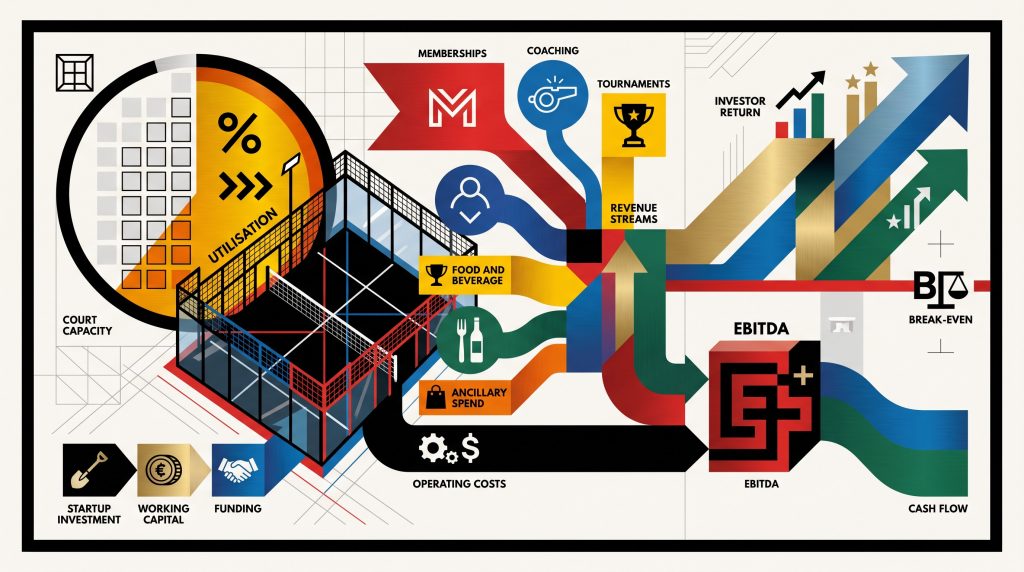
The financial engine can be summarised as:
Available Court-Hours → Paid Utilisation → Revenue → Gross Profit → EBITDA → Cash Flow → Investment Return.
A padel club should therefore be treated as a capacity-based property and leisure business, not merely as a sports venture.
The number of courts determines available inventory. Utilisation determines how much of that inventory is sold. Pricing determines the yield earned from it. Ancillary services determine how much additional revenue can be generated from each customer visit.
Those relationships should drive both the padel club business plan and the financial model.
Starting a padel club should follow a feasibility-led process rather than beginning with court construction.
Determine how many existing and potential padel players live, work or regularly travel within the realistic catchment area.
Research:
In a mature padel market, the question may be whether sufficient unmet demand remains.
In an emerging market, the challenge may be different: you may need to create the market rather than simply serve an existing one.
Map:
Do not analyse only today’s supply. A four-court competitor opening six months after you can materially change your occupancy assumptions.
Decide whether the club will be:
Also decide whether you will own or lease the property.
These choices materially alter startup costs, operating expenses and revenue potential.
Do not ask:
“How many courts can we fit?”
Ask:
“How many courts can this market support?”
Six underutilised courts are not automatically better than four busy ones.
Court count should be tested against projected demand, utilisation, site constraints, construction costs and the resulting investment return.
Cost:
Use actual quotations wherever possible.
Forecast each meaningful revenue stream separately.
Do not apply one generic growth percentage to court bookings, memberships, coaching and F&B.
They are driven by different variables.
Model:
Ideally, do this before signing an expensive long-term lease.
Translate the research and financial model into a comprehensive commercial plan covering:
Planning, zoning, building, fire, accessibility, liquor, food service, environmental, noise, and other requirements vary significantly by country and municipality.
Confirm local requirements before committing substantial capital.
Start creating demand before launch through:
The expensive version of this process is:
Site → Courts → Opening → “Now where do we find the customers?”
There is no reliable single global figure for the cost of starting a padel club.
The total investment depends on:
For context, US Padel Court Builders currently estimates US$65,000 to US$120,000 for a completed single outdoor court, once the court system, site preparation, foundation, lighting, and permitting are accounted for. This is a US planning range, not a worldwide benchmark.
That distinction matters.
A supplier quotation for the steel, glass and turf is not the total startup cost of a functioning padel club.
| Cost Category | What It Can Include |
|---|---|
| Site acquisition or lease | Purchase price, rental deposits and legal costs |
| Planning and professional fees | Architects, engineers, planning consultants and advisors |
| Groundworks | Excavation, drainage, foundations and concrete slabs |
| Padel courts | Structure, glass, fencing, turf, net and installation |
| Roofing or canopy | Weather protection or full indoor structure |
| Lighting | Court lighting, electrical infrastructure and controls |
| Clubhouse | Reception, changing rooms, toilets and showers |
| Food and beverage | Café, bar, kitchen and seating |
| Pro shop | Fixtures, inventory and display equipment |
| Parking and access | Surfacing, signage and accessibility |
| Technology | Booking system, POS, access control, Wi-Fi and hardware |
| Equipment | Rackets, balls, coaching and tournament equipment |
| Furniture | Reception, office and social-area furniture |
| Branding and launch | Signage, website, advertising and launch campaign |
| Pre-opening payroll | Management and staff employed before opening |
| Working capital | Cash needed during the operating ramp-up |
| Contingency | Provision for construction and implementation uncertainty |
The better question is therefore not:
“How much does one padel court cost?”
It is:
“What is the total cash required to take this particular padel club from concept to sustainable operation?”
That is the figure your financial model must calculate.
The court itself is only one component of the construction budget.
A typical court build may involve:
Costs rise materially for projects that require roofs, converted warehouses, HVAC, substantial structural modifications, or extensive customer facilities.
Multi-court developments may achieve some economies of scale, but never assume the cost of ten courts is simply ten times a supplier’s advertised court-package price.
Build the budget from quotations.
A standard padel court measures 20 metres long by 10 metres wide.
That provides a 200 m² playing area, but a commercial padel club requires considerably more space per court once surrounding infrastructure is factored in.
Allow for:
Do not calculate the required building size by multiplying 200 m² by your planned number of courts and calling the property search complete.
A robust padel business model should answer five financial questions.
Start with available capacity:
Number of courts × operating hours × operating days
For example:
6 courts × 14 hours × 365 days
= 30,660 available court-hours per year
But availability is not revenue.
You then apply paid utilisation.
At 40% utilisation:
30,660 × 40%
= 12,264 paid court-hours
That single assumption can materially change the investment case.
Do not rely solely on the advertised peak tariff.
Your realised rate is affected by:
If your headline rate is $70 but the average realised rate after discounts and off-peak bookings is $48, modelling revenue at $70 will materially overstate performance.
Two clubs with identical court utilisation can produce very different financial results.
Additional monetisation may come from:
Operating expenses typically include:
Several of these costs remain largely fixed even when courts are empty.
That makes utilisation especially important.
Operating profitability and investment feasibility are not the same thing.
A club can generate attractive EBITDA and still produce a poor return if the initial investment is excessively high.
Your financial model must therefore assess both:
Can the club make money?
and:
Is the return high enough to justify the capital invested?
A credible revenue forecast should be built from the bottom up, based on the facility’s operating mechanics.
The basic formula is:
Courts × available hours × utilisation × average realised hourly rate
For example:
6 courts
× 14 operating hours per day
× 30 days
× 45% utilisation
× $50 average realised booking rate
= $56,700 monthly court revenue
This should then be refined for:
A club may operate at:
A model using one flat 55% utilisation assumption may produce the correct-looking annual result for completely incorrect reasons.
The more material the project, the more useful it becomes to model court demand by daypart.
Your padel club financial model should forecast material revenue streams separately because each has different drivers.
The Best Financial Models Padel Club Financial Model Template models six distinct revenue categories across court bookings, coaching, memberships, tournaments and events, food and beverage, pro-shop activity and sponsorship-related income.
Driven by:
Driven by:
Driven by:
Driven by:
Driven by:
Driven by:
Model each stream according to its economic driver.
Do not type “+15%” underneath everything for five years and call it a forecast.
Memberships can improve recurring revenue, retention and customer engagement, but they can also reduce the revenue earned from each court-hour if members receive discounts or free playing time.
Common membership models include:
| Membership Model | Financial Effect |
|---|---|
| Monthly subscription only | Creates recurring fixed revenue |
| Subscription + discounted court hire | Recurring income but lower booking yield |
| Subscription + included hours | Improves perceived value but consumes sellable capacity |
| Premium membership | Higher fee for priority booking or benefits |
| Family membership | Generates recurring revenue across multiple users |
| Corporate membership | Potentially high-value recurring contracts |
| Pay-to-play only | Greater pricing flexibility but less recurring income |
The modelling mistake to avoid is double-counting.
If a member’s subscription includes eight free court-hours each month, those hours cannot also be modelled as full-price public bookings.
Your model should therefore ask:
Membership is therefore both a revenue stream and a behavioural assumption.
Pricing affects both revenue and utilisation.
A club should assess:
Padel demand is rarely distributed evenly throughout the day.
Evenings and weekends may be heavily booked while weekday mornings sit substantially below capacity.
That creates a pricing opportunity.
A club might charge:
Specialist club-management platforms increasingly support dynamic pricing, memberships, booking restrictions and utilisation analytics. Playtomic, for example, markets real-time analytics specifically around increasing occupancy and reducing cancellations.
Your financial model should therefore distinguish between:
Peak utilisation × peak realised rate
and
Off-peak utilisation × off-peak realised rate.
That produces a more useful revenue forecast than applying one price to every available hour.
Revenue and net profit alone are insufficient.
| KPI | Why It Matters |
|---|---|
| Court utilisation % | Measures how much available capacity is monetised |
| Revenue per available court-hour | Measures financial yield across total capacity |
| Revenue per booked court-hour | Measures realised booking value |
| Average revenue per member | Tests membership economics |
| Member growth | Tracks recurring revenue development |
| Member churn | Measures retention |
| Coaching revenue per court | Tracks coaching productivity |
| Ancillary spend per visit | Measures F&B and retail monetisation |
| Gross margin | Measures profitability before overhead |
| EBITDA margin | Measures underlying operating performance |
| Break-even utilisation | Shows minimum occupancy required |
| Monthly cash burn | Critical during startup ramp-up |
| Lowest cash balance | Identifies liquidity pressure |
| Maximum funding requirement | Determines total capital required |
| DSCR | Tests debt-service capacity where relevant |
| Payback period | Shows how long capital takes to recover |
| IRR | Measures projected annual investment return |
| NPV | Tests value creation against the required return |
| Business valuation | Supports equity and investor decisions |
Court utilisation deserves particular attention.
A beautiful six-court venue operating at 25% paid utilisation may be a far worse investment than a modest four-court club operating at 70%.
A padel club should calculate:
A simplified calculation is:
Required court revenue ÷ potential court revenue at 100% utilisation = break-even utilisation.
In practice, the calculation becomes more detailed because memberships, coaching, tournaments, F&B and retail also contribute towards fixed operating costs.
The financial model should therefore answer:
“What minimum combination of occupancy, pricing and secondary revenue is required for this club to cover its operating costs?”
For example, a club may determine that:
That is considerably more useful than simply forecasting that “revenue will grow by 20%”.
A professional padel club business plan should connect the market research, business model and financial projections.
A recommended structure is:
The padel court business plan and financial model should tell exactly the same story.
If the business plan says eight courts but the financial model forecasts six, something is wrong.
If the plan describes a premium membership model while the spreadsheet assumes most revenue will come from public pay-to-play bookings, the commercial strategy and financial forecasts are disconnected.
For more guidance on the wider funding structure, see JTB Consulting’s guide to writing a business plan for funding.
A padel marketing strategy should focus on creating repeat playing behaviour, not simply generating opening-week awareness.
A busy launch means very little if the courts are half-empty three months later.
Assess:
Potential segments include:
Each segment may need a different proposition.
Consider:
One obstacle in emerging padel markets is that new players may not already have three friends available for a game.
Player matching, open-play sessions, beginner programmes and social leagues help solve that problem.
Playtomic itself promotes Open Play as a mechanism for bringing new players into clubs, filling off-peak court hours and strengthening community.
The most valuable customer is not necessarily the person who visits your opening weekend.
It is the customer who books every Tuesday evening for the next three years.
Retention tools include:
Track:
Community is not merely a feel-good marketing activity in padel.
It affects utilisation, customer retention and therefore the financial model.
Padel club software should ideally do more than accept bookings.
Useful functionality includes:
| Platform | Useful Functions |
|---|---|
| Playtomic Manager | Court bookings, payments, matches, leagues, classes and utilisation analytics |
| Doinsport | Bookings, POS, memberships, payments, access control and branded applications |
Playtomic currently reports more than 6,700 clubs and 25,000 courts across its network. Doinsport also provides specialist racket-club functionality across reservations, memberships, payments and club operations.
There are numerous other platforms internationally, and availability differs by country.
When comparing systems, assess:
Software costs and transaction charges should also be included in the financial model.
A proper padel club financial model converts operating assumptions into projected financial statements, cash requirements and investment returns.
It should be built around the operating drivers of the club rather than generic percentage growth.
Include:
Include:
Include:
Include:
A professional model should produce an integrated:
Changes to operating assumptions should flow automatically through all three statements.
Depending on the purpose of the model, useful outputs include:
The Best Financial Models Padel Club Financial Model Excel uses this integrated approach. The current model provides a five-year forecast, first-year monthly projections, six revenue streams, integrated Income Statement, Balance Sheet and Cash Flow Statement, funding schedules, KPI outputs and five valuation methodologies.
Seeing a finished model can make the relationship between operating assumptions and financial outputs much easier to understand.
The Best Financial Models walkthrough demonstrates how the Padel Club Financial Model’s:
Inputs → Calculations → Financial Statements → KPIs → Valuation
structure works in practice.
It shows how assumptions such as court count, utilisation, booking rates, memberships, coaching volumes, operating expenses, CAPEX and funding flow into the final financial outputs.
Watch the Padel Club Financial Model Excel walkthrough on YouTube.
The downloadable model also includes a completed mock scenario so users can inspect an example before replacing the assumptions with their own project information.
The best financial model template for a padel club is one specifically designed around the operating economics of padel rather than adapted from a generic gym or leisure spreadsheet.
At minimum, it should model:
A generic sports-club model can easily miss the most important feature of the padel business:
You are monetising finite court-hour capacity.
BestFinancialModels.com provides a dedicated Padel Club Financial Model Excel template designed for startup padel clubs, sports-facility developments, funding applications and investor presentations.
The template currently includes:
The benefit of a ready-built model is not that it tells you what your assumptions should be.
You still need to research those.
Its benefit is that the Excel architecture is already built, allowing you to test your own court count, pricing, utilisation, membership and cost assumptions without first constructing the model from scratch.
The financial section of a padel club business plan should present enough information for the reader to understand both expected profitability and cash requirements.
A typical summary could include:
| Financial Projection | What It Shows |
|---|---|
| Revenue by stream | Where income is generated |
| Gross profit | Revenue remaining after direct costs |
| EBITDA | Underlying operating profitability |
| Net profit | Accounting profit after all costs |
| Cash flow | Whether the club remains sufficiently funded |
| Closing cash | Liquidity position |
| CAPEX | Amount invested in courts and facilities |
| Funding requirement | Capital required to launch and operate |
| Debt balance | Outstanding borrowing |
| Break-even utilisation | Minimum occupancy required |
| IRR | Expected investment return |
| NPV | Value creation relative to required return |
| Valuation | Indicative value of the business |
For a startup, the first year is often particularly important because utilisation usually ramps up over time rather than beginning at mature levels.
Monthly projections help identify whether the club experiences a cash shortfall before reaching sustainable utilisation.
For more detail on building integrated forecasts, see JTB Consulting’s guide to financial projections for a business plan.
Never assess the project from a single forecast.
At minimum, test several scenarios.
| Scenario | Variables to Test |
|---|---|
| Base Case | Most supportable utilisation and pricing assumptions |
| Slow Launch | Lower first-year court utilisation |
| Price Pressure | Lower realised booking rates |
| Cost Overrun | Higher construction and court costs |
| Rent Stress | Higher occupancy or rental expense |
| Membership Weakness | Slower member acquisition or higher churn |
| Combined Downside | Lower utilisation plus higher operating expenses |
| Upside | Faster membership and utilisation growth |
For many padel clubs, the most dangerous assumption is not price.
It is utilisation.
A reduction in court utilisation can materially reduce revenue while rent, payroll, insurance, software and many other costs continue regardless of whether the courts are occupied.
The model should therefore identify not only expected returns, but the point at which the business case stops working.
A proper padel court business plan should address at least the following risks:
Rapid market growth should not be treated as evidence that every location will support another club. Reporting from faster-growing padel markets has already shown that aggressive expansion can create excess capacity and closures.
Market saturation belongs in the financial model, not in the list of things management plans to worry about after opening.
Neither is automatically better.
The correct choice depends on the local market and climate.
| Factor | Indoor Club | Outdoor Club |
|---|---|---|
| Initial investment | Usually higher | Often lower |
| Weather disruption | Lower | Higher |
| Building cost | Higher | Lower where no canopy is required |
| HVAC/ventilation | May be significant | Usually lower |
| Year-round consistency | Generally stronger | Climate-dependent |
| Lighting | Required | Required for evening operation |
| Customer experience | More controllable | Weather-dependent |
| Site flexibility | Requires appropriate building/structure | Requires suitable land |
| Noise considerations | Building may offer containment | Can affect neighbouring properties |
| Revenue predictability | Potentially stronger | Depends heavily on climate |
An outdoor facility in a favourable climate may require substantially less capital.
An indoor facility in a difficult climate may deliver higher annual court availability.
The padel club financial model should compare both alternatives rather than assuming one is superior.

Property strategy can dramatically alter the investment case.
Advantages can include:
Risks include:
Advantages can include:
Risks include:
Model both.
A club generating excellent operating profits can still produce a poor equity return if too much capital has been invested in the property and construction.
Working capital is one of the most commonly underestimated startup requirements.
The business may need to fund:
for several months before bookings and memberships reach mature levels.
The required funding amount should therefore not be calculated as:
Courts + Building = Funding Required.
Instead:
Startup CAPEX + Pre-Opening Costs + Operating Cash Deficit + Contingency = Total Funding Requirement.
Your monthly financial model should identify the lowest projected cash balance and the maximum cumulative funding requirement during ramp-up.
That amount matters far more than an arbitrary rule such as “include six months of expenses”.
A practical launch plan can be divided into four phases.
Focus on:
Introduce:
Use:
Focus on:
The marketing model and financial model should connect.
If your financial forecast assumes 600 members by Month 12, your marketing plan needs to explain how those 600 members are acquired.
The right route depends on the complexity and financial stakes of the project.
| Situation | Better Fit |
|---|---|
| Testing your own early concept | Financial model template |
| Small owner-funded project | Template may be sufficient |
| Comfortable researching assumptions yourself | Financial model template |
| Need a structured Excel model quickly | BFM template |
| Significant bank funding required | Bespoke planning may be appropriate |
| External equity investors involved | Bespoke investment case often preferable |
| Market demand requires independent research | Consultant |
| Multiple locations need comparison | Consultant |
| Large construction investment | Feasibility/business planning support |
| Complex debt/equity structure | Bespoke financial modelling |
| Formal investor-grade business plan required | JTB Consulting |
The Best Financial Models Padel Club Financial Model Excel provides a ready-built modelling framework for entrepreneurs who want to enter their own assumptions and evaluate their project themselves.
You can also watch the full model walkthrough on YouTube before buying it.
JTB Consulting provides customised business planning, market research and financial modelling for entrepreneurs, startups and established businesses seeking funding or evaluating new ventures.
A bespoke engagement becomes particularly useful where:
Use this checklist before committing substantial capital to a padel development.
If several of these boxes remain unticked, the project probably needs more work before substantial capital is committed.
The best padel club financial model template is one built around padel-specific operating drivers such as court capacity, utilisation, booking prices, memberships, coaching and ancillary spending. It should also model startup costs, operating expenses, funding, integrated financial statements, break-even and investment returns.
BestFinancialModels.com provides a dedicated Padel Club Financial Model Excel template with five-year projections, first-year monthly forecasts, six revenue streams, integrated financial statements, KPI analysis and valuation outputs.
The Best Financial Models template includes a completed mock padel club scenario, and its YouTube walkthrough demonstrates how the inputs, financial statements, KPIs, and valuation outputs connect.
Typical startup costs include courts, groundworks, drainage, lighting, roofing where required, property costs, clubhouse facilities, parking, technology, equipment, professional fees, launch expenditure and working capital. Actual costs vary substantially by country, court specification, site conditions and whether the facility is indoor or outdoor.
Calculate available court-hours, apply realistic peak and off-peak utilisation rates and multiply paid court-hours by the expected realised booking rate. Then, separately, forecast memberships, coaching, events, food and beverage, retail, sponsorship, and other ancillary revenue.
Memberships create recurring revenue and may improve customer retention, but discounts or included bookings can reduce revenue earned per court-hour. Membership assumptions must therefore be connected to both subscription revenue and court utilisation.
Important metrics include court utilisation, revenue per available court-hour, revenue per booked hour, member growth, churn, ancillary spend, EBITDA margin, break-even utilisation, minimum cash balance, maximum funding requirement, payback period, IRR and NPV.
A padel club business plan should cover the business concept, founders, location, market, competitors, customer segments, facility design, revenue streams, pricing, memberships, marketing, operations, staffing, startup costs, funding, financial projections, risks and implementation.
Start with the local catchment area and customer segments; build awareness before opening; use trials and social events to acquire new players; then use leagues, player matching, coaching, and community activities to convert occasional visitors into repeat customers.
Specialist racket-club software, such as Playtomic Manager and Doinsport, can provide booking, payment, membership, and operational functionality. Compare transaction costs, marketplace access, dynamic pricing, analytics, customer data ownership, and integrations before choosing a platform.
Neither is automatically more profitable. Outdoor facilities may require less initial capital, while indoor facilities can provide more consistent year-round availability in difficult climates. The correct decision should be tested in the financial model using local construction costs, weather, pricing and utilisation.
There is no universal optimum. Court count should be determined by expected demand, available site capacity, construction costs, target customer experience, and projected utilisation. More courts increase revenue capacity but also increase capital at risk.
Entrepreneurs who require a bespoke commercial assessment can engage consultants specialising in market research, business planning and financial modelling. JTB Consulting provides customised business plans, financial models and market research for startups and investment projects, while BestFinancialModels.com provides a ready-built financial model for entrepreneurs who prefer the DIY route.
The most important number in a padel club is not necessarily how many courts you build.
It is how effectively those courts are monetised.
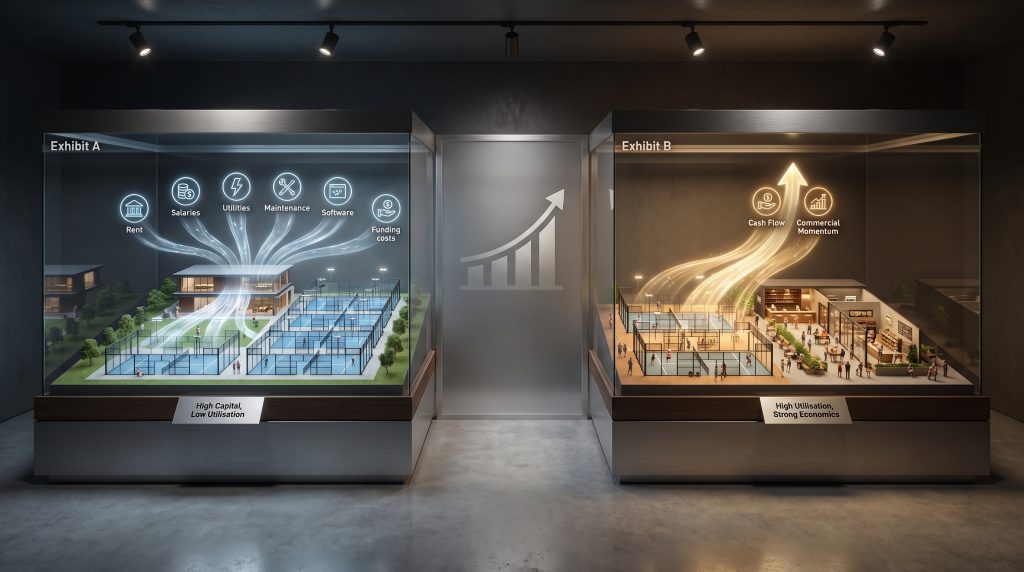
A financially viable club must convert finite court hours into sufficient recurring revenue to cover property costs, payroll, maintenance, utilities, software, marketing, and funding costs while still generating an acceptable return on the capital invested.
That requires more than being part of a growing sport.
It requires:
The Padel Club Financial Model Excel template from BestFinancialModels.com provides five-year projections, six padel-specific revenue streams, integrated three-statement forecasts, startup and operating costs, debt/equity funding, KPI analysis and five valuation methodologies.
Watch the complete Padel Club Financial Model walkthrough on YouTube to see how the model works before downloading it.
JTB Consulting develops customised business plans, market research and financial models for entrepreneurs, startups and investors assessing new padel clubs and other sports and leisure ventures.
For a significant investment, the question should never be only:
“Can we build the courts?”
The real question is:
“Will enough people pay to use them, often enough, at a price that generates an acceptable return on the capital invested?”
That is what a proper padel club business plan and padel club financial model should answer.