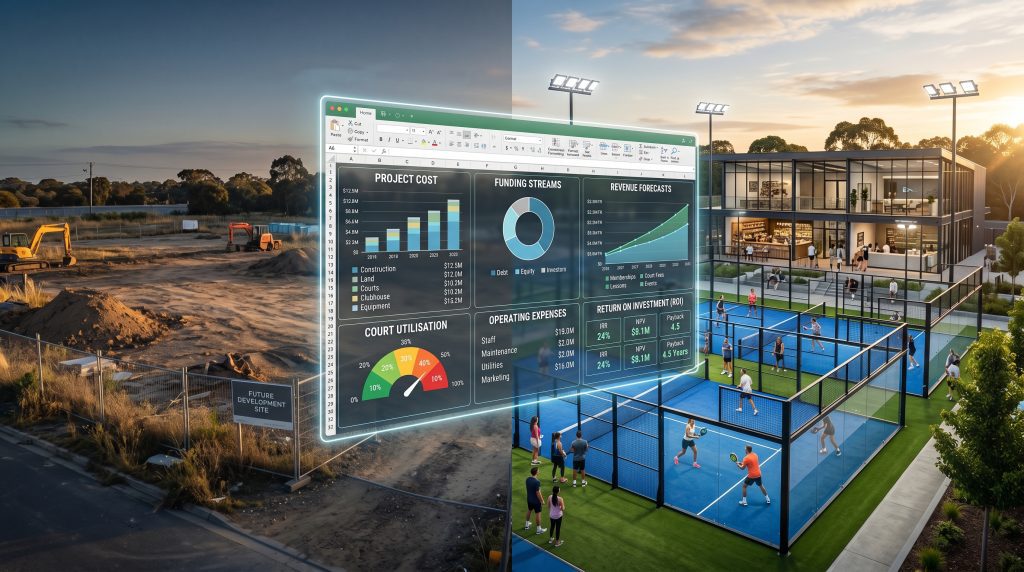
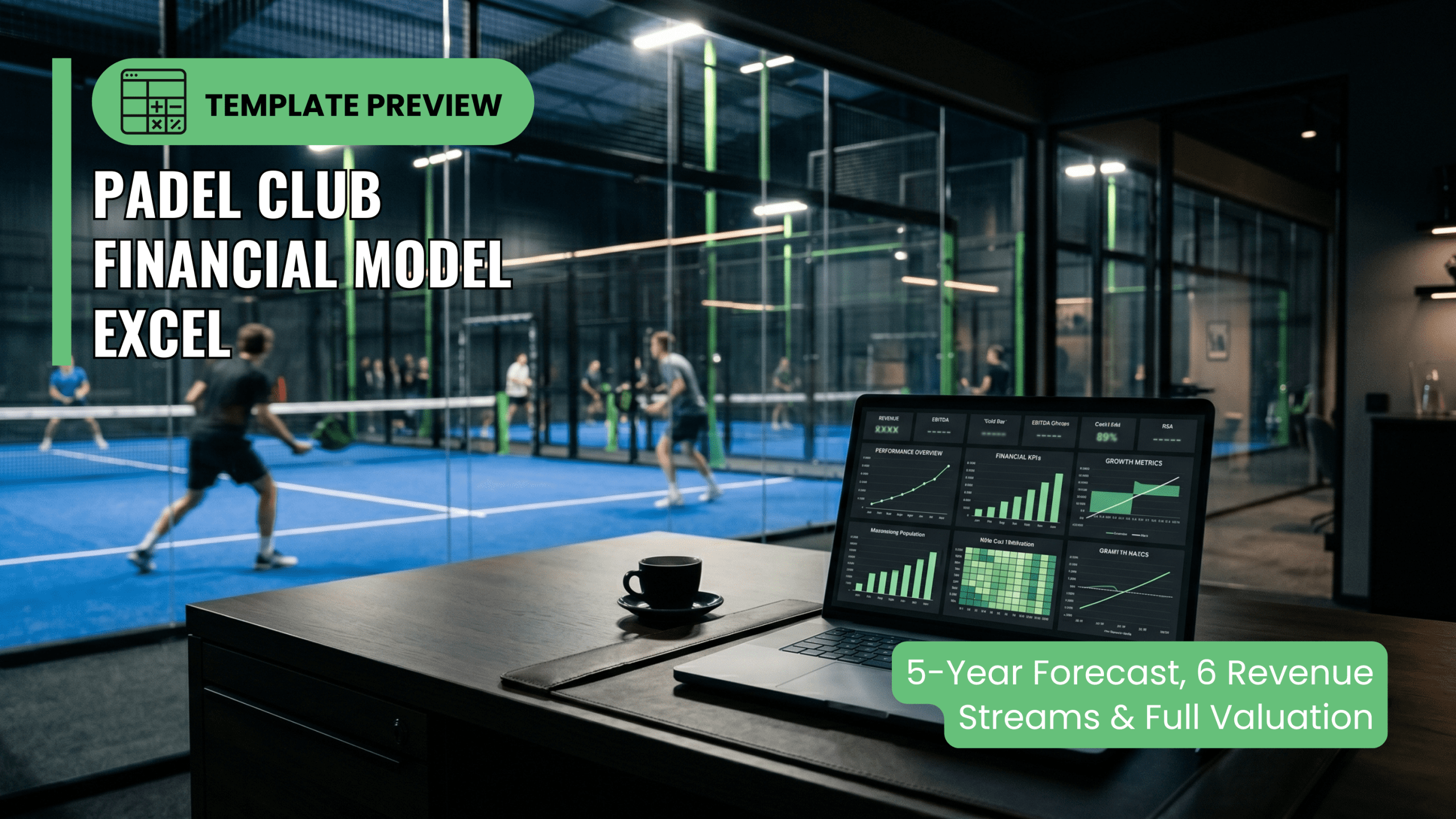
If you’re launching a padel club and need a financial model that gives you real answers — what revenue you’ll generate, when you’ll break even, and what your club is worth to an investor — this is the template that does that work for you.
The padel club financial model Excel covers your complete five-year financial picture across 6 distinct revenue streams: court rental, tournaments and events, coaching and membership, and ancillary revenue — bar and restaurant, pro shop, and sponsorships. Every assumption you enter — court count, booking rates, membership growth, coaching hours, ancillary yields — flows automatically into your Income Statement, Balance Sheet, and Cash Flow Statement. You receive fully integrated three-statement financials without having to build a single formula yourself.
This padel court financial model template includes a fully completed mock scenario — a real-world padel club example that shows you exactly how inputs, calculations, and outputs connect before you replace anything with your own numbers. You see the finished model working before you start, not after.
The Inputs → Calculations → Outputs architecture keeps the process clean. You adjust your assumptions in the inputs section, and every financial statement, KPI dashboard, and valuation output updates automatically across the entire five-year forecast. No formula editing. No manual recalculations.
Open the inputs section and work through each revenue stream in sequence. Set your core padel court assumptions — court count, average game duration, operating hours, court occupancy rate, and average players per game.
Define your coaching and membership assumptions, and add coaching program volumes, separating group from private sessions. Set ancillary revenue targets for F&B and pro shop, tournament event frequency, and any sponsorship deals.
On the cost side, you enter staffing costs (split between direct and indirect labour), coach utilisation, maintenance budgets (including surface resurfacing schedules), marketing spend, and other related operating expenses. Every input you change triggers seamless updates across all outputs — statements, dashboards, and valuation tables.
Six revenue streams are individually modelled, each with its own utilisation drivers, pricing inputs, and volume assumptions. Court occupancy is tracked by weekend and midweek splits with separate rate settings.
Coaching revenue separates group and private lesson pricing with volume drivers. Ancillary revenue tracks F&B and merch yield per visitor. Events and tournaments carry their own frequency and pricing inputs. Sponsorship deals are structured with their own deal values and renewal logic.
The padel club revenue model Excel component automatically calculates totals across all six streams and feeds them directly into the operating cost model. That model handles labour and coach utilisation rates, surface maintenance, marketing, financing, and capital expenditure — all of which are phased and linked. The output is three integrated financial statements with full valuation metrics, tracking EBITDA ramps, DSCR profiles, and free cash flow across the five-year horizon.
You walk away with an investor-ready Excel file that a bank, DFI, or private equity investor can open and interrogate — with visible formulas, auditable logic, and no black-box calculations hidden from scrutiny.
Specifically, this padel club financial model Excel delivers:
Building a reliable padel club financial model from scratch typically takes three to four weeks for an experienced financial modeller — and a single miscalculated formula can produce funding projections that collapse under investor due diligence.
This padel club financial model template gives you a professionally structured, fully auditable framework built around the revenue drivers and cost dynamics specific to padel club operations. You spend your time on your business, not on spreadsheet architecture.
The padel club financial model Excel template delivers a structured five-year startup forecast, three integrated financial statements, a five-method valuation, and a KPI dashboard — all in a single, immediately downloadable Excel file. It is designed for padel club founders, sports investors, financial advisors, and anyone preparing a funding application or investor presentation for a padel club startup.
Whether you need a padel club investor-ready financial model for a private equity presentation, a padel club business plan financial model to accompany a bank application, or a padel court financial model template to evaluate a greenfield development, this Excel file covers all of those use cases in one structured, auditable file.
Before you purchase, watch the step-by-step video walkthrough. It shows you exactly how the template is structured, how your inputs flow into financial outputs, and what the finished, investor-ready dashboard looks like. No surprises. You know exactly what you are buying before you download.
Know What You’re Buying — Watch Before Purchasing.
Watch the Padel Club Financial Model Excel Template Video Walkthrough.
The use of this financial model is solely at the user’s own risk. Best Financial Models provides the template as a tool to assist users in their business planning and decision-making processes. However, the responsibility for adhering to the model’s instructions and guidelines lies entirely with the user. Best Financial Models cannot and will not be held liable for any inaccuracies, errors, or unintended outcomes resulting from the user deviating from the prescribed usage, including but not limited to the deletion, addition, or modification of rows, columns, formulas, or any other components of the model. Users are strongly advised to exercise caution when making any changes to the model to ensure its integrity and reliability are maintained.
| Business Type | Padel Club |
|---|---|
| File Format | Microsoft Excel |
Yes. This padel club financial model Excel is a professionally structured, immediately downloadable template covering five years of financial projections, 6 revenue streams, 3 integrated financial statements, and 5 valuation methods. It includes a fully completed mock scenario, so you can see the entire model in action before you replace the assumptions with your own figures.
Enter your operational assumptions — court count, booking rates, membership targets, coaching volume, and cost structure — and the model calculates all projections automatically. The Inputs → Calculations → Outputs architecture links every assumption directly to your Income Statement, Balance Sheet, and Cash Flow Statement, so your five-year projections update across all three statements the moment you change an input.
The model covers 6 distinct revenue streams: court bookings with separate weekend and midweek pricing, membership income, coaching programs that separate group and private sessions, food-and-beverage ancillary revenue, tournament and event income, and sponsorship deals. Each stream has its own dedicated input section and utilisation logic, keeping your assumptions clean and traceable.
Five valuation methods are built in: Discounted Cash Flow (DCF), EBITDA and Sales multiples (both Enterprise and Equity values), and asset-based. This range lets you present the most relevant valuation approach to your specific investor or lender — whether that is a private equity firm, a commercial bank, or a development finance institution evaluating your padel club application.
You input your court count and set midweek and weekend booking rates separately, along with pricing for each slot type. The model converts these assumptions into occupancy percentages, revenue per court, and total booking income across the five-year forecast. It also allows court occupancy levels to be included, as these affect the availability of courts for the rest of the revenue streams — for example, tournaments and coaching sessions — a figure most lenders will ask for.
This template produces the financial documents banks and investors require: a five-year Income Statement showing your profitability trajectory, a Cash Flow Statement demonstrating liquidity and debt serviceability, and a Balance Sheet showing your asset and liability position. The model also calculates DSCR (Debt Service Coverage Ratio) automatically — a standard lending requirement for padel club loan applications.
A credible padel club financial model must include individually modelled revenue streams, a full operating cost schedule, a phased capital expenditure schedule, and three integrated financial statements. It also requires valuation outputs — DCF and relevant multiples — and an automated KPI dashboard that tracks the metrics funders interrogate: break-even point of sales, EBITDA margin, Debt Service Coverage Ratio (DSCR), free cash flow, unlevered and levered IRR, cash burn, cash runway, funding/investment level adequacy, profitability margins, and revenue growth. This template includes all of these components in a single, auditable Excel file.
Yes — the template is structured specifically for investor presentations and funding applications. The outputs include auditable three-statement financials, five valuation methods, and an automated KPI dashboard. Every formula in the model is visible and traceable, meeting the due diligence standards of banks, development finance institutions, and private equity investors evaluating padel club business plans.
Building a reliable padel club financial model from scratch typically takes three to four weeks for an experienced financial modeller with knowledge of sports facilities. This template reduces that to hours. You enter your assumptions, the model calculates everything automatically, and you produce investor-ready outputs the same day you download the file — without writing a single formula.
The automated KPI dashboard tracks the metrics that banks and investors focus on: break-even point of sales, EBITDA margin, Debt Service Coverage Ratio (DSCR), free cash flow, unlevered and levered IRR, cash burn, cash runway, funding/investment level adequacy, profitability margins, and revenue growth over a five-year forecast. Every KPI updates automatically when you adjust your operating assumptions — no manual recalculation required.
The best padel club financial model Excel template is one that covers all major revenue streams, produces fully integrated three-statement financials, includes multiple valuation methods, and ships with a completed example so you can see the model working before you start. This template covers all of those criteria — 6 revenue streams, 5 valuation methods, automated Income Statement, Balance Sheet, and Cash Flow Statement, with a pre-populated mock scenario included.
A padel club business plan typically requires three financial statements: an Income Statement showing revenue, costs, and profitability across the forecast period; a Cash Flow Statement demonstrating liquidity and debt serviceability; and a Balance Sheet showing the club’s asset and liability position at each year-end. This template produces all three automatically from your operating assumptions, fully integrated and auditable.
A padel club financial model is the quantitative core of your business plan — the Excel-based forecasting tool that produces your revenue projections, cost schedules, financial statements, and valuations. A business plan is the broader document that contextualises those numbers with market research, strategy, and operational detail. Banks and investors require both the financial model for due diligence and the business plan for strategic context. This template delivers the financial model component.
BestFinancialModels.com offers a dedicated padel club financial model Excel template specifically built for sports facility startups. It covers court bookings, membership, coaching, food and beverage, events, and sponsorship revenue streams — the standard operating model for racket-sport and padel club businesses. A broader all-purpose 10-year financial model template with integrated SWOT analysis is also available in the template library for facility types that don’t fit the padel-specific model.
This Padel Club Financial Model Excel Template is a five-year forecasting, feasibility and valuation model built for padel club startups, sports facility developments and racket-sport investment opportunities. It helps founders, entrepreneurs, investors, banks, development finance institutions and advisors assess whether a padel club is financially viable before committing capital.
The model converts court count, booking rates, court utilisation, memberships, coaching sessions, tournaments, sponsorships, food and beverage sales, pro shop income, staffing costs, rent, operating expenses, CAPEX, funding assumptions and debt repayment terms into automated financial statements, valuation outputs and investor-ready KPIs.
Designed for padel club business plans, bank loan applications, investor presentations, startup feasibility studies and expansion decisions, the template produces a fully linked Income Statement, Balance Sheet and Cash Flow Statement across a five-year forecast. Users can test revenue assumptions, funding needs, break-even timing, cash runway, profitability, DSCR, IRR, debt serviceability and investor returns in a single structured Excel file.
This Padel Club Financial Model Excel template is designed for padel club founders preparing funding applications, entrepreneurs testing a new sports facility concept, banks reviewing loan applications, private investors assessing returns, development finance institutions evaluating debt serviceability, consultants preparing client forecasts, and existing padel club operators planning expansion, refinancing or valuation.
This product page includes a step-by-step video walkthrough and sample PDF preview pages so users can see exactly how the Padel Club Financial Model Excel template is structured before purchasing.
The walkthrough shows the full Inputs → Calculations → Outputs flow, including court utilisation, revenue modelling, operating costs, startup costs, funding assumptions, financial statements, KPI dashboard, valuation schedules and investor-ready outputs.
This preview is useful for anyone who needs a credible, presentation-ready financial forecast for a padel club without having to build a model from scratch.
Before committing capital, read our complete guide to starting a profitable padel club. It covers startup costs, court utilisation, revenue forecasting, memberships, pricing, break-even analysis, marketing, club management software, funding requirements, and how to structure both your padel club business plan and financial model.
Read the Complete Padel Club Business Plan & Financial Model Guide →
R999.00
We accept various methods of payment, including Visa, Mastercard, and EFT.
Our site is secured with SSL certification and we do not store any of your payment details.
Immediate access to your chosen financial model, compatible with Excel or Google Sheets.
Our templates are designed for global use, featuring support for all major currencies.
Need more than the financial model? JTB Consulting provides bespoke Padel Club Business Plans, market research and integrated financial modelling for entrepreneurs, startups and investors seeking funding or assessing new padel developments.


We don’t spam, and you can always opt out at any time.