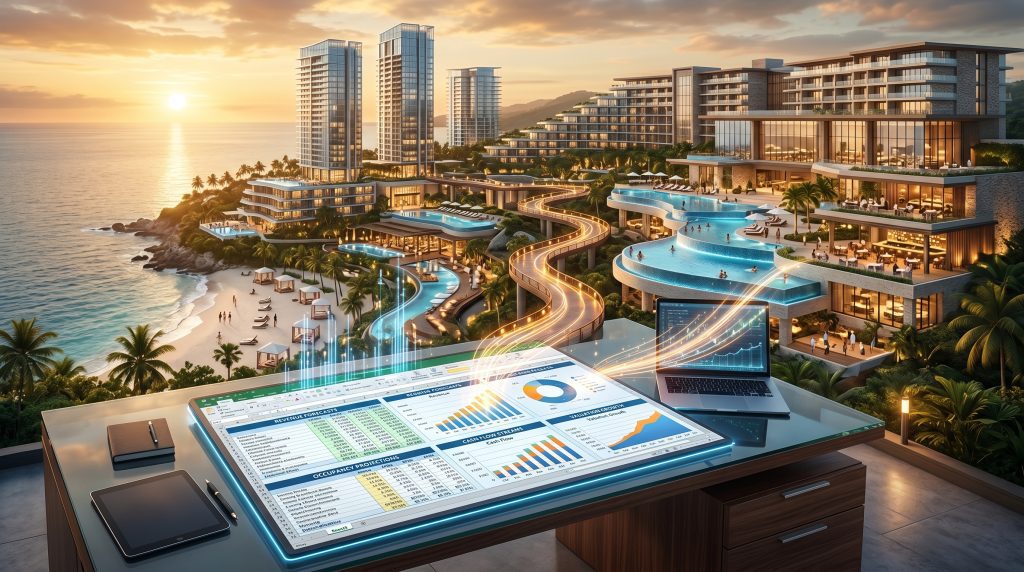
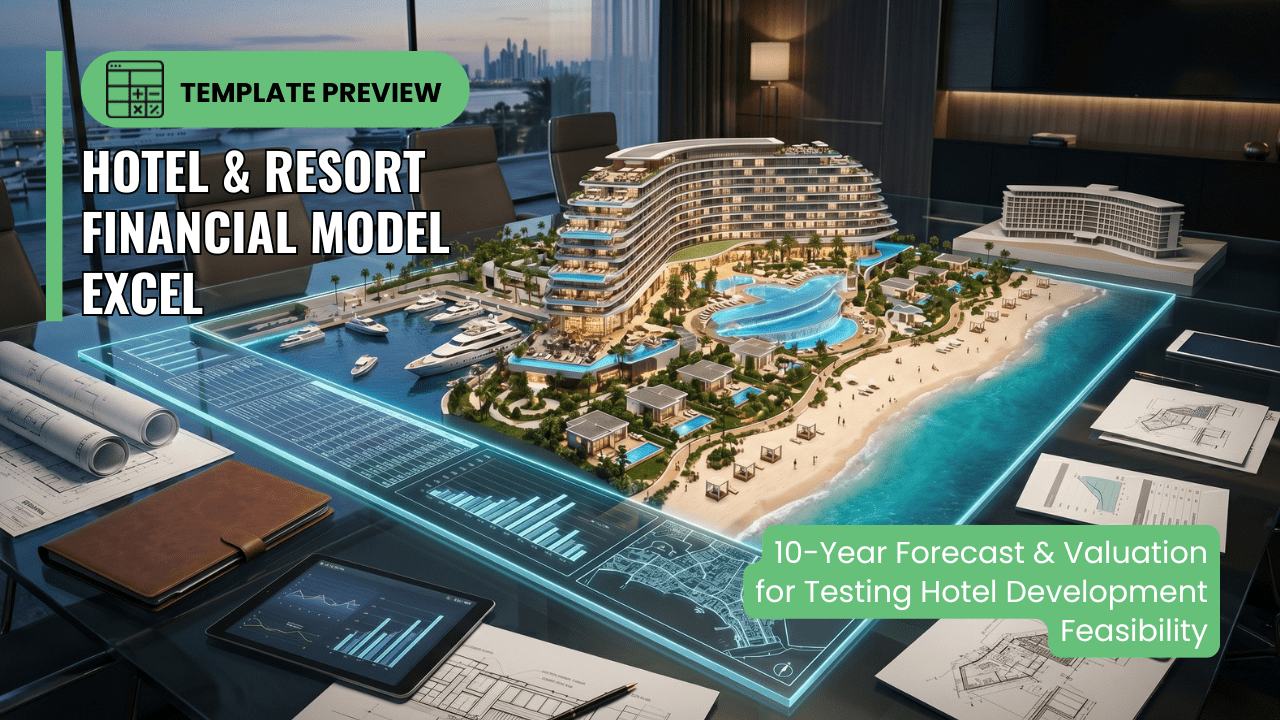
This hotel financial model Excel rigorously evaluates the viability of hotel and hospitality development across a full 10-year horizon, capturing construction-to-stabilisation economics with industry-standard precision. It transforms granular operational drivers—room inventory by category, occupancy ramps, ADR trajectories, ancillary revenues (F&B, parking, restaurants)—into integrated financial projections that mirror authentic hotel P&L volatility, seasonal patterns, and cash cycles.
Seamlessly linking build-phase Capex outflows, ramp-up EBITDA bridges, and terminal value exits, the model equips developers, lenders, and investors for feasibility stress tests, precise capital structuring, and profitability benchmarking aligned with hotel business plans.
The hotel financial model leverages a bulletproof Inputs → Calculations → Outputs workflow, empowering seamless customisation by hospitality professionals. Users begin by entering assumptions regarding room mix, pricing, occupancy, operating costs, construction Capex, and financing. These inputs automatically update the 10-year financial projections without modifying core formulas.
The Excel design supports scenario testing and sensitivity analysis, allowing users to assess downside and upside cases, which are commonly required for feasibility studies and funding discussions. This workflow ensures auditability and consistency, making the model appropriate for advisors preparing financial projections, developers refining a hotel business plan, or investors reviewing project risk.
The model produces fully integrated income statements, balance sheets and cash flow forecasts over 10 years. It calculates hospitality-specific KPIs, including ADR, RevPAR, GOPPAR, and TRevPAR, and links them directly to revenue and cost drivers. The financial projections incorporate construction cash flows, operational ramp-up, ongoing expenses and financing schedules.
Valuation outputs include IRR, NPV and payback metrics aligned with standard feasibility study practices and industry standards for the valuation of hospitality projects. All calculations are transparent and Excel-based, enabling market research assumptions, operational drivers and funding structures to be reviewed and adjusted without obscuring financial logic.
Users receive a structured Excel financial model that supports hotel feasibility studies, funding applications and long-term strategic planning. Practical outcomes include clear visibility of cash flow timing, capital requirements and investor returns across the development lifecycle.
The model enables comparison of alternative operating assumptions, financing structures and performance scenarios, supporting evidence-based decisions rather than narrative estimates. Outputs are suitable for inclusion in hotel business plans, lender packs, and investor presentations, ensuring consistency between the strategic narrative, financial projections, and market assumptions.
Building a hotel financial model from scratch requires significant time and introduces structural risk. This hotel financial model Excel template embeds established financial modelling logic, hospitality KPIs and valuation methodologies in a tested structure. Users can focus on refining assumptions informed by market research and feasibility analysis rather than constructing formulas.
This hotel financial model template reduces errors, improves consistency, and accelerates the preparation of bankable financial projections, making it a more reliable foundation for hotel business plans and funding discussions than ad hoc spreadsheets.
This hotel financial model Excel integrates construction costs, operational performance, valuation metrics and financing into a single 10-year forecasting framework. It supports feasibility studies, hotel business plans and investor analysis through transparent financial projections, hospitality KPIs and valuation outputs.
The model is designed for professional use in funding, planning and decision-making contexts where accuracy, auditability and clarity are essential.
For users who would like to review the template before purchasing, a concise video walkthrough is available that demonstrates the functionality of this hotel development financial model Excel file. The video shows how development costs, financing assumptions, and operating projections are structured within the model, as well as the type of long-term financial outputs generated over a 10-year horizon.
Our walkthrough is intended to help developers, investors, and advisors understand what the template delivers and how it supports financial projections and feasibility analysis for hotel development projects.
Know What You’re Buying—Watch Before Purchasing This Hotel Financial Model Excel Template.
View our Hotel Financial Model Excel Template Video Walkthrough.
| Component | Description |
| Industry-Specific KPIs | Calculates key hotel performance metrics including ADR, RevPAR, GOPPAR, CPOR, and occupancy rate. |
| Multi-Stream Revenue Model | Includes revenue from up to 20 room types, casino operations, golf courses, event spaces, parking, retail leasing, and entertainment facilities. |
| Hotel Room Revenue Forecasting | Tracks total rooms available, total rooms occupied, occupancy rates, and variable costs per room. |
| Food and Beverage / Restaurant Leasing | Forecasts lease income from on-site restaurants, bars, and food courts. |
| Casino Revenue and Visitor Analytics | Calculates hotel guest and non-hotel visitor capture rates to determine casino revenue potential. |
| Golf Course and Sporting Events | Projects membership fees, event sponsorships, and guest revenues. |
| Water Parks and Exclusive Dining | Includes financial forecasts for water park entrance fees and high-end dining experiences. |
| Retail and Commercial Leasing | Tracks monthly leases from retail stores, spas, and lifestyle services. |
| Parking Revenue Model | Calculates parking bay usage, hourly rates, and total billed hours. |
| Luxury and Boat Chartering | Forecasts revenue from boat excursions, luxury charters, and adventure tourism. |
| Event and Conference Bookings | Includes financial projections for conferences, weddings, and corporate functions. |
| Debt and Equity Financing Models | Evaluates loan terms, investor equity scenarios, and payback periods. |
| Equity Investor What-If Analysis | Provides a robust investment analysis tool for structuring investor equity negotiations. |
| Break-Even and Sensitivity Analysis | Determines profitability based on pricing adjustments, occupancy rate fluctuations, and operational cost changes. |
| Pre-Populated Mock Scenario | Includes a realistic sample case study to guide users in applying the model. |
The use of this financial model is solely at the user’s own risk. Best Financial Models provides the template as a tool to assist users in their business planning and decision-making processes. However, the responsibility for adhering to the model’s instructions and guidelines lies entirely with the user. Best Financial Models cannot and will not be held liable for any inaccuracies, errors, or unintended outcomes resulting from the user deviating from the prescribed usage, including but not limited to the deletion, addition, or modification of rows, columns, formulas, or any other components of the model. Users are strongly advised to exercise caution when making any changes to the model to ensure its integrity and reliability are maintained.
| Business Type | Hotel Development |
|---|---|
| File Format | Microsoft Excel |
A hotel financial model Excel is a structured forecasting tool that converts operational and financial assumptions into long-term financial projections for a hotel development. Developers rely on it to assess feasibility, funding requirements and investment returns before committing capital. This hotel financial model Excel integrates revenue drivers, operating costs, construction expenditure and valuation metrics into a coherent framework. It supports hotel business plans and feasibility studies by aligning assumptions with cash-flow forecasts and return analyses. Using a structured Excel model improves credibility with lenders and investors, as it demonstrates disciplined financial planning rather than narrative estimates, reducing decision risk at early project stages.
Funding decisions depend on credible financial projections and transparent assumptions. This hotel financial model Excel converts feasibility assumptions into integrated financial statements, enabling lenders and investors to assess cash flow sufficiency, return potential and risk. By calculating IRR, NPV and payback alongside operating KPIs, the model supports evidence-based funding discussions. Scenario testing allows users to stress-test performance under different market conditions, which is critical for lender review. Because projections are linked and auditable, the model aligns financial projections with the hotel business plan and market research assumptions typically required in bank and investor submissions.
The model tracks core hospitality performance metrics such as ADR, RevPAR, GOPPAR and TRevPAR, linking them directly to operational and cost assumptions. In addition, it calculates valuation and funding metrics, including IRR, NPV and payback period over the 10-year forecast. These metrics are derived from integrated financial projections rather than standalone calculations, ensuring consistency. Tracking these indicators allows developers, investors and advisors to evaluate profitability, operating efficiency and investment viability in a structured feasibility study context, supporting informed decisions on pricing, scale and funding strategy.
Yes. The hotel financial model Excel can be adapted for resort and mixed-use hospitality developments that combine accommodation with additional revenue streams. Users can model different room categories, pricing structures and ancillary revenues while maintaining integrated financial projections. Construction and operating costs can be adjusted to reflect the complexity of resort developments. By consolidating these elements into a single Excel model, users can assess feasibility, valuation and funding implications without fragmenting analysis. This makes the model suitable for broader hospitality feasibility studies and investment assessments beyond single-asset hotels.
The model includes structured CAPEX planning that reflects land acquisition, construction costs and FF&E expenditure over the development period. These capital costs are phased and linked to depreciation within the financial projections. By integrating CAPEX timing with cash flow forecasts, users can assess funding requirements and liquidity during construction. This level of detail supports feasibility studies and funding analysis by aligning capital expenditure with financing assumptions. It also allows developers to test alternative construction timelines and cost assumptions, improving capital planning accuracy.
Generic spreadsheets often lack integration between operations, financing and valuation. This hotel financial model Excel embeds hospitality-specific drivers, integrated financial projections and valuation logic within a single framework. The structure supports feasibility studies, business plans and funding analysis without relying on disconnected worksheets. Transparency and consistency reduce modelling risk and improve auditability. For developers and advisors, this approach provides a defensible financial foundation aligned with professional expectations, rather than a collection of assumptions that require extensive rework for lender or investor review.
Revenue forecasting is based on room inventory, occupancy assumptions and pricing inputs defined by the user. These assumptions drive room revenue and are supplemented by additional hospitality income streams where applicable. The model translates these inputs into monthly and annual financial projections, ensuring that revenue assumptions align with operating costs and cash-flow timing. This approach supports feasibility studies and hotel business plans by linking market research assumptions to financial outcomes. Changes to occupancy or pricing assumptions automatically update projections, enabling scenario analysis and sensitivity testing.
The discounted cash flow valuation calculates the present value of projected hotel cash flows over the forecast period. Users define discount rates and exit assumptions consistent with feasibility study practices. The model computes IRR and NPV based on integrated cash flows rather than isolated valuation sheets. Sensitivity analysis allows users to test how changes in occupancy, pricing, or costs affect valuation outcomes. This supports investor decision-making and capital allocation analysis using methodologies commonly accepted in hospitality investment evaluation.
Yes. The model can support existing hotels by projecting future performance under expansion, refurbishment or refinancing scenarios. Users can adjust assumptions to reflect current operations and proposed changes, generating updated financial projections and valuation outputs. This supports funding discussions, strategic planning and feasibility analysis for existing assets. By aligning projections with revised business plans and market assumptions, the model provides a structured basis for lender engagement and investment review.
This hotel financial model Excel file is suited to developers, investors, financial advisors, and consultants involved in hotel feasibility studies, business plans, and funding preparation. It provides structured financial projections and valuation outputs required for decision-making across development, investment and financing contexts. The model supports strategic planning, market-informed analysis and funding discussions without requiring bespoke model construction. Its Excel-based design ensures accessibility while maintaining professional analytical standards.
Feasibility studies require alignment between market assumptions, operating performance and financial outcomes. This hotel financial model Excel integrates these elements into a single forecasting framework. By linking occupancy, pricing and cost assumptions to financial projections and valuation metrics, the model enables an objective assessment of project viability. Scenario testing allows users to assess downside risk and upside potential, supporting go-or-no-go decisions based on evidence rather than narrative projections.
Yes. The financial projections produced by the model align directly with hotel business plans by translating strategic assumptions into quantified outcomes. Revenue, cost and capital assumptions used in the business plan can be reflected in the model, ensuring consistency. This alignment strengthens credibility with investors and lenders, as the narrative strategy is supported by transparent financial forecasts and valuation outputs suitable for funding review.
The 10-year forecast horizon allows users to assess long-term performance beyond initial stabilisation. This supports strategic planning decisions relating to pricing strategy, cost management and capital structure. By modelling different scenarios, users can evaluate how market changes affect financial sustainability. This long-term perspective is particularly valuable in hospitality projects where capital intensity and operating cycles require forward-looking analysis.
Yes. The model produces integrated financial statements, valuation metrics, and KPIs commonly reviewed by lenders and investors. Its transparent Excel structure allows assumptions to be audited and stress-tested. This supports funding applications and investment review processes by providing a clear, consistent financial narrative aligned with feasibility and market research inputs.
Financial planning risk is reduced by using a structured, integrated model rather than fragmented spreadsheets. This hotel financial model Excel ensures consistency across assumptions, projections and valuation outputs. Scenario testing highlights sensitivities before capital is committed, supporting disciplined decision-making. This reduces reliance on intuition and improves the quality of feasibility studies and funding submissions.
This Hotel Financial Model Excel template is a 10-year forecasting, feasibility and valuation model built for hotel developments, resorts, casino hotels, mixed-use hospitality projects and destination properties. It helps developers, investors, lenders, advisors, and hospitality operators assess financial viability, funding requirements, investor returns, and long-term cash flow performance before committing capital.
The hotel development financial model converts hotel room inventory, occupancy rates, ADR, RevPAR, GOPPAR, CPOR, construction CAPEX, operating expenses, debt and equity funding, and multiple hospitality revenue streams into integrated financial statements, valuation outputs, and investor-ready KPIs.
Designed for hotel business plans, feasibility studies, funding applications, investor presentations, valuation work and strategic planning, the template produces linked 10-year income statement, cash flow and balance sheet forecasts. Users can test development costs, operating assumptions, funding structures, debt repayment, IRR, NPV, payback period, break-even performance, valuation outcomes, and investor return scenarios in a single transparent Excel file.
This Hotel Financial Model Excel template is designed for hotel developers, resort sponsors, hospitality investors, lenders, private equity firms, real estate investment groups, hotel executives, franchise operators, financial advisors and consultants preparing feasibility studies, funding applications, business plans, investment memorandums, valuation work or board-level decision packs.
This product page includes a step-by-step video walkthrough and sample PDF preview pages so users can see exactly how the Hotel Financial Model Excel template is structured before purchasing.
The walkthrough shows the full Inputs → Calculations → Outputs flow, including room revenue, ancillary income, construction costs, development timelines, operating expenses, funding assumptions, financial statements, KPI dashboard, valuation schedules and investor-ready outputs.
This preview is useful for anyone who needs a credible hotel feasibility forecast, funding model, valuation tool, or investor-ready financial model without having to build a complex spreadsheet from scratch.
R1,999.00
We accept various methods of payment, including Visa, Mastercard, and EFT.
Our site is secured with SSL certification and we do not store any of your payment details.
Immediate access to your chosen financial model, compatible with Excel or Google Sheets.
Our templates are designed for global use, featuring support for all major currencies.
Do you need a Hotel Business Plan or Resort Business Plan? Partner with Africa’s Leading Business Plan Experts, JTB Consulting—trusted by entrepreneurs since 2006.


We don’t spam, and you can always opt out at any time.